topic

Exhibition Views: Artistic Research Projects

TOPIC CONTENT:

Part of AIL’s exhibition program, curated by the Executive Board, is based on research projects affiliated with the University of Applied Arts Vienna.

As an important link between the university and the general public, AIL makes current projects accessible, connects them to other fields of knowledge and science and makes the university’s organizational and content-related resources available to all interested parties.

Find below a selection of exhibitions coming from the field of artistic research. Some of the exhibitions were the closing presentation of projects, some gave insights into running processes and work in progress.

image

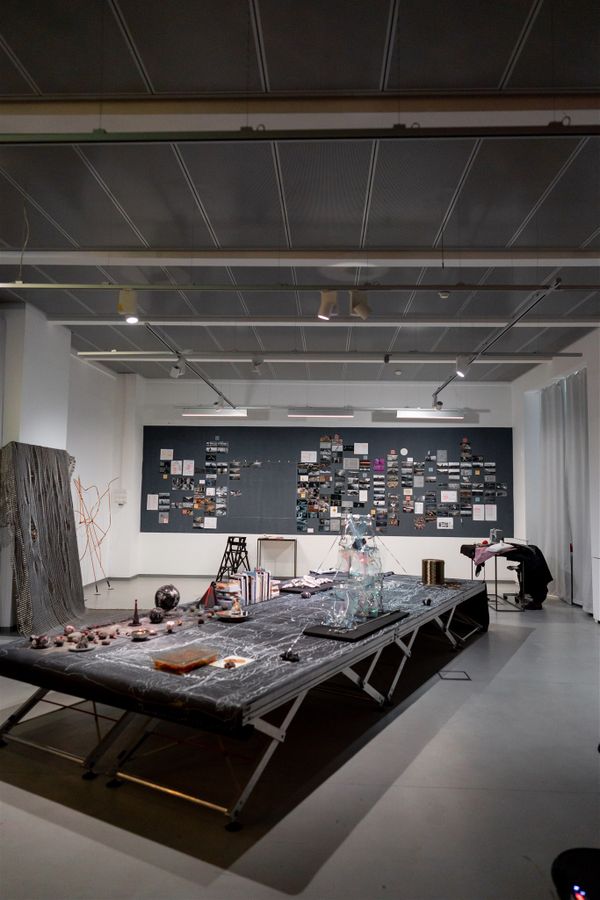
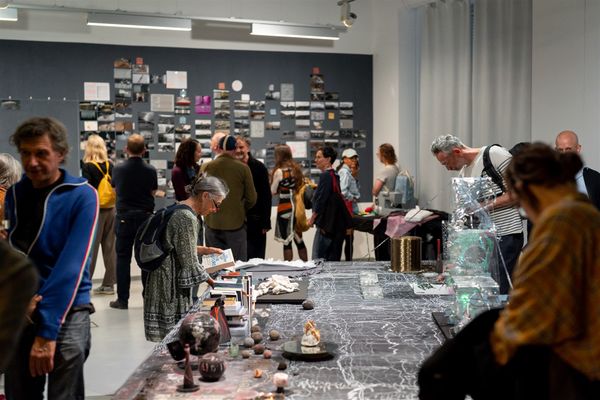
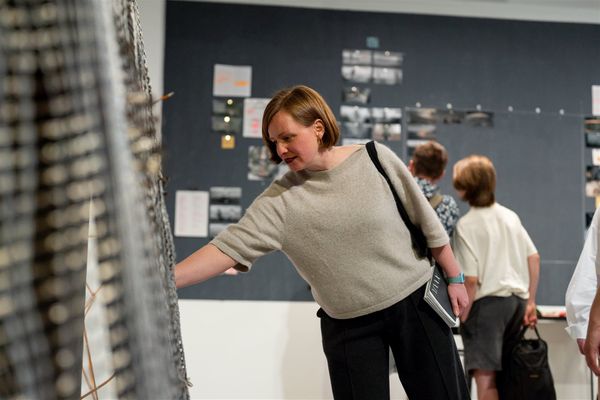
Exhibition View: Reflecting Oil. Petroculture in Transformation

Artistic Research Project Led by Artist Ernst Logar. Oct / Nov 2024

The exhibition intensively explores the substance of oil in connection with various concepts and phenomena of our petromodernity

Image by ©

Oil constitutes one of the most important resources of the modern age in our global society. In light of increasing planetary warming, we are on the brink of a radical transformation into a post-fossil era. For a successful transition towards a sustainable future, understanding our present day culture in terms of its entanglements with the oil industry is a prerequisite.

Image by ©
Image by ©

The exhibition Reflecting Oil, part of the eponymous artistic research project led by artist Ernst Logar, intensively explores this substance in connection with various concepts and phenomena of our petromodernity.

Image by ©
Image by ©
Image by ©
Image by ©

The departure points for the exhibition are interdisciplinary workshops and crude oil experiments in cooperation with the Montanuniversität Leoben (University of Leoben Department of Geoscience, formerly Department of Petroleum Engineering), the Petrocultures Research Group (University of Alberta, Canada), and international experts from diverse fields of knowledge.

Image by ©
Image by ©

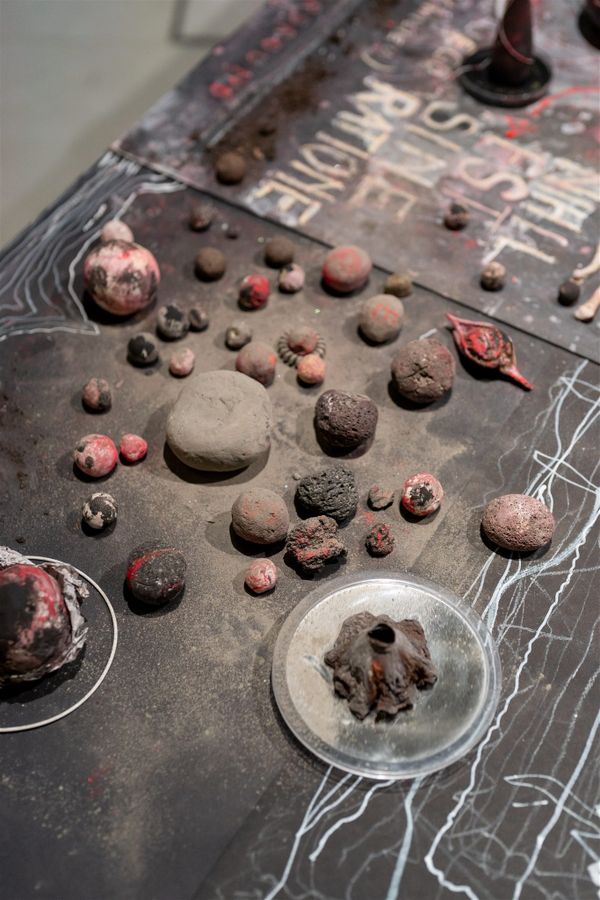
The exhibition investigates the resource fossil and its impacts on our society from various angles. A holistic view of crude oil is needed to understand the substance in all of its facets. To this end, a focus is placed on the perception of its sensual qualities (e.g. color and smell) and presenting crude oil experiments, which Ernst Logar has taken as the basis for the exhibited artistic works. In a separate exhibition area, the artist sheds light on how petroculture, spurred by the crude oil refining process, influences global mobility, modern lifestyles, and the world of consumer goods.

Image by ©
Image by ©
Image by ©Ernst Logar (Head of the artistic research project Reflecting Oil) and Alexander Damianisch (Head of Support Kunst und Forschung) at the opening of the exhibition

The featured artistic works reflect petrocultural phenomena in our contemporary culture. In addition to Logar’s works, the exhibition showcases the artistic and scientific explorations of the participants of the Reflecting Oil Colloquium (Angewandte, June 2022). The results of this interdisciplinary research project provide important insights for the necessary social, cultural, and technological changes towards sustainable energy sources.

Vienna team: Ernst Logar, Michaela Geboltsberger, Leonhard Gruber, Paula Bosbach, Alejandra Rodríguez-Remedi, Agnes Tatzber, Monika Vykoukal, Lisa Marie Weidl

Leoben team: Holger Ott, Karez Abdulhameed, Pit Arnold, Bianca Brandstätter, Boris Jammernegg, Patrick Jasek, Michael Koopmans, Jakob Kulich, Horst Resch, Gerald Stiedl 

Petrocultures team: Imre Szeman, Sheena Wilson

The diverse experiments and artistic works were developed in the course of the arts-based research project Reflecting Oil: Arts-Based Research on Oil Transitionings (FWF-PEEK Project AR547, 2019-2024)

Ernst Logar (*1965 in Klagenfurt, Austria) is an artist and cultural worker, active in the fields of photography, film, video, sound, sculpture, and installation. In addition to international exhibition activities and interdisciplinary collaborations with various experts and institutions, Logar realizes projects in public space and site-specific works that tackle prevailing power relations as well as contemporary historical, sociocultural, ecological, and socio-political phenomena.

His works have been presented in the Austrian Parliament, at the scenes of Nazi crimes, and other locations relevant to his artistic engagement. Logar is active in local cultural politics and is currently a research assistant and lecturer at the University of Applied Arts Vienna.

All images: Lea Dörl

image

Exhibition View: Shaken Grounds

Seismography of Precarious Presences

The exhibition is running 5–26 May 2026. Guided Tours: 12 & 26 May, 17:00

Not only natural but also anthropogenic forces give rise to (or intensify) seismic processes. What forms of precarity shape this socio-geological dynamic, and what new uncertainties does it produce?

How do human and more-than-human actors move on ground that is increasingly unstable – geologically, politically, and existentially?

Situated at the intersection of artistic research, geology, somatic practices, performance art, and film making, the project understands seismography as an open, transdisciplinary practice: a method of perceiving, translating, and relating bodies, technologies, and the planet Earth at sites of heightened seismic activity.

SPACE RIGHT

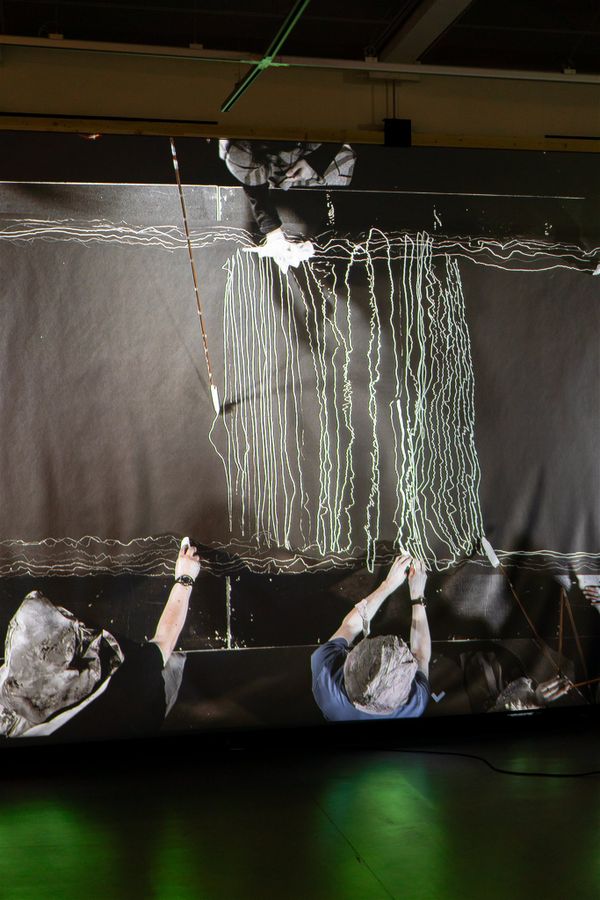
Image by ©Shaken Grounds: Gleaning from the Riffs, Spatial Installation, 2026, Nikolaus Gansterer, Mariella Greil, Victor Jaschke, Peter Kozek, Werner Moebius, Lucie Strecker
Image by ©
Image by ©
Image by ©
Image by ©

Shaken Grounds. Seismography of Precarious Presences is a transdisciplinary artistic research project that explores the interconnections between geological, social, and psychological upheavals. Starting point is the observation that not only natural processes but also human interventions such as climate change and technological interventions influence seismic dynamics and alter the stability of our environment.

At the center is the question of how these tremors inscribe themselves in bodies, environments, and social contexts. Seismography is understood here not only as a scientific method, but as an artistic practice of perception and relating. In this context, a “trembling thought” (Édouard Glissant) emerges, one that detaches itself from the notion of solid ground and engages with movements, shifts, and transitions.

Shaken Grounds brings together artists, scientists, and curators to develop new perspectives on the relationship between the body, technology, and the earth. Diverse media and practices, including performance, film, drawing, sound, and somatic approaches, enter into a dialogue with geological processes.

The exhibition presents the results of the research project of the same name funded by the Austrian Science Fund (FWF) and also marks the launch of the Creative Europe project Shaken Grounds: Art as Seismography, co-funded by the European Union.

SPACE LEFT

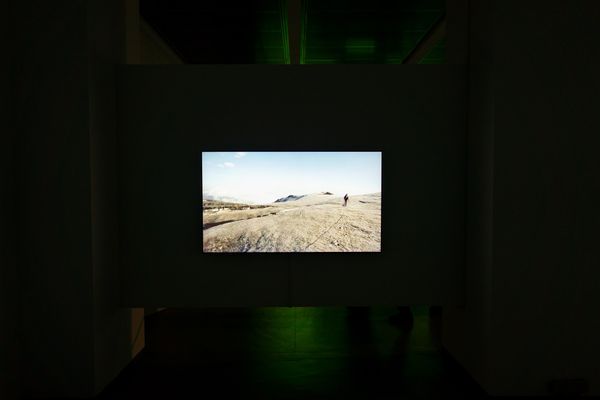
Image by ©Infinite Next, Anna Líndal, Video loop, 2012
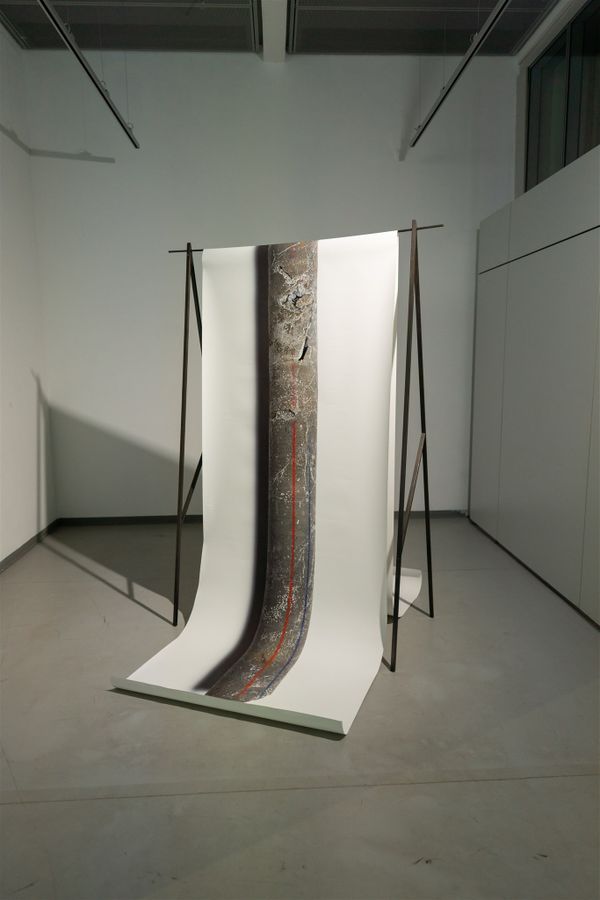
Image by ©Ten Thousand an One Years, Installation, 2016, Bjarki Bragason
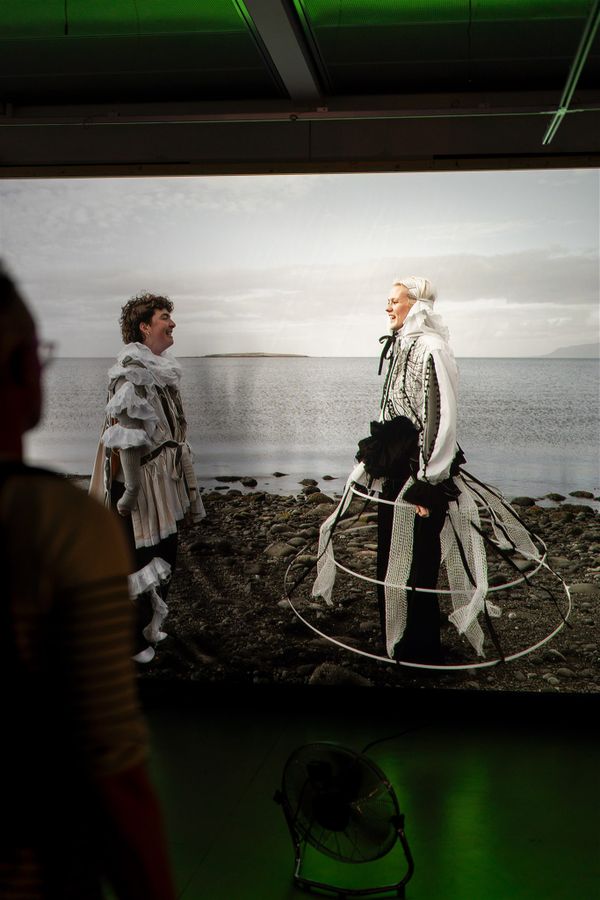
Image by ©Shaken Grounds: Hell is Empty, Three-channel Film Installation, 2026, Nikolaus Gansterer, Mariella Greil, Victor Jaschke, Peter Kozek, Werner Moebius, Lucie Strecker
Image by ©

With contributions by:

Bjarki Bragason, Nikolaus Gansterer, Mariella Greil, Victor Jaschke, Peter Kozek, Anna Líndal, Werner Moebius, Lucie Strecker

In artistic and scientific dialogue with:

Valerio Acocella, Arno Böhler, Alexander Damianisch, Wolfgang Fiel, Oscar Fernandez Bellon, Helga Franza, Nicolas Freytag, Sabine Folie, Aleksandar Gabrovski, Vesna Meštrić, Susanna Ravelli, Sylvia Scheidl, Ana Škegro, Sandra Ó. Snæbjörnsdóttir, Kaloyan Vasev, VestAndPage, Sandro de Vita, Mauro di Vito

Image by ©Welcom by rector Ulrike Kuch

The exhibition presents findings from the research project Shaken Grounds. Seismography of Precarious Presences (funded by Austrian Science Fund (FWF): AR 780. DOI: 10.55776) and also marks the launch of the Creative Europe project Shaken Grounds: Art as Seismography (funded by the European Union).

Views and opinions expressed are however those of the author(s) only and do not necessarily reflect those of the European Union or the European Education and Culture Executive Agency (EACEA). Neither the European Union nor EACEA can be held responsible for them. 

All photos: Lea Dörl

image

Exhibition View: The Unexpected

Enquiries on Human-AI Interaction

Exhibition from May–July 2025. Artists: Pamela Breda, Patrícia J. Reis, Ruth Schnell

How do we navigate the intricate dance between human agency and artificial intelligence? This exhibition stands as a profound exploration of the emotional and cognitive landscapes reshaped by AI, prompting a critical speculation of our future.

In an era marked by rapid technological evolution, the interplay between human cognition and artificial intelligence (AI) invites both fascination and trepidation. The exhibition The Unexpected. Enquiries on Human-AI Interactions explores these dynamics and serves as the culminating event of the PEEK project with the same title. This exhibition features the works of project leader Pamela Breda and the project collaborators Patrícia J. Reis and Ruth Schnell – artists whose pursuit traverse complex landscapes of emotional, cognitive and exploitative responses to AI.

The Unexpected invites you to a deeper contemplation of the philosophical, ethical and societal ramifications of AI. The shown artworks tell us about the labyrinth of human-AI relations with a critical and reflective lens and also address broader themes of human behavior – like the fear of change, and the relentless drive of capitalism that propels technological advancement, underscoring the duality of AI as both a marvel of human ingenuity and a potential harbinger of unforeseen challenges.

Image by ©Traces of Control, Interactive mixed media installation, 2025

Patrícia J. Reis and Ruth Schnell extend this topic through an interactive mixed reality installation that reconfigures the very space of the exhibition. Utilizing 3D mapping technologies and the head mounted display – HoloLens, they create an immersive environment that references the application of AI in several controversial domains resulting in the proliferation of autonomous weapons, brain hacking technologies, data labor exploitation, sexbots, and the relentless persistence of extractivism practices.

The central topics extend from the virtual environment into the physical exhibition space through the materialization of objects and artifacts made from materials that are integral within the AI technosphere. Reis's and Schnell's pieces invite viewers to engage critically in a speculative narrative that navigates between physical and virtual space.

Credits:

Mixed media installation:

Concept and production:
Patrícia J. Reis and Ruth Schnell

3D printing: Klemens Kohlweis

Tailoring and Embroidery: Erika Farina

Interactive mixed reality headset (HoloLens 2):

Artistic concept and direction:
Patrícia J. Reis and Ruth Schnell

Technology architect: Thomas Hochwallner
Actors: Sarah Jeanne Babits, Therese Cafasso,
Randall Galera, Deborah Gzesh

Harmony (3D animation): Joanna Zabielska

Image by ©

About the artist Patrícia J. Reis and Ruth Schnell:

Patrícia J. Reis (PT) is a media artist and researcher exploring human and more-than-human entanglements with technology. Drawing from media theory, gender studies, and new materialism, she examines parallels between human and machine operations, playfully engaging with bodily sensory mechanisms. She is a Postdoctoral Senior Researcher leading Hacking the Body as the Black Box (Elise Richter-Programm) at the University of Applied Arts Vienna, where she has lectured at the department of Digital Arts since 2015.

Ruth Schnell (AT) headed the Department of Digital Art at the University of Applied Arts Vienna until fall 2023. Her work particularly encompasses interactive video environments, dynamic projections, and light installations, engaging intensely with questions of perception. A central aspect of her practice is the exploration of political and social issues, as well as the nature of the world and society. Her current artistic research focuses on the immersive aspects of mixed-reality environments.

Image by ©Synthetic Dreams, Experimental documentary, 4K, 1.77:1, 117’, 2025

Pamela Breda presents a filmic narrative delving into the future of humanity entwined with AI. Her work will pose philosophical inquiries into the symbiosis and potential friction between human intellect and machine learning. Drawing on the insights of contemporary philosophers such as Luciano Floridi and Rosi Braidotti, Breda's film contemplates the ontological shifts precipitated by AI. It challenges viewers to ponder whether our evolving relationship with artificial intelligence augments human experience or subtly erodes the essence of our humanity.

Image by ©

Credits:

Actors: Sara Herrlander, Yoachim Auvray

Soundtrack: Emanuele Wiltsch Barberio

Sound Design: Alessandro Peiretti

Camera Assistant: Lorenzo Truco

Bibliographical references:

James Bridle, The New Dark Age: Technology and the End of the Future, London, Verso (2018), Henry Kissinger, Eric Schmidt, Daniel Huttenlocher, The Age of AI: And Our Human Future, New York, Houghton Mifflin Harcourt (2021) Patricia MacCormack, Posthumanism: The Future of Homo Sapiens, Cambridge, Polity Press (2020), Stuart Russell, If We Succeed, New York, Penguin (2022), Alvin Toffler, Future Shock, New York, Random House (1970), Sherry Turkle, The Second Self: Computers and the Human Spirit, Cambridge, MA, MIT Press (2005)

About the artist Pamela Breda:

Pamela Breda (IT) is an artist, filmmaker, and researcher, currently a Module Leader in Cinema at Arts University Bournemouth. Her research explores contemporary image-making, focusing on digital imagery’s impact on perception, memory, and how history is transformed through technological mediation. She has held residencies at Villa Medici (Rome), Cité Internationale des Arts (Paris), and Pratt Institute (New York). Her films have been featured in global festivals, including Sheffield DocFest and Visions du Réel.

Photos: Lea Dörl

image

Exhibition View: Reverse Imagining Vienna

Anthropogenic Mass and Its Speculative Futures

Research Presentation from May 2024

Image by ©
Image by ©
Image by ©
Image by ©
Image by ©
Image by ©
Image by ©
Image by ©
Image by ©
Image by ©
Image by ©

The exhibition Reverse Imagining Vienna is the final presentation of the artistic research project of the same name. Sculptures, scientific analyses of the nine anthropogenic materials and the first volume of a publication containing the resulting literary contributions are on display. Four readings by the participating authors will take place as part of the exhibition.

Download the publication here

Since 2020, the global stock of man-made mass has exceeded the total sum of biomass on Earth – around 90 percent of which is building materials. In the project Reverse Imagining Vienna, two sculptors and nine writers took a Viennese Gründerzeit building and the Prater Bridge, which crosses over the Danube, as material and speculative anchors in which to gain perspectives on sustainable relationships with inanimate matter. Referring to so-called reverse engineering, the two structures were deconstructed and recomposed in a historical, material-analytical, poetic and visionary way using reverse imagining.

Over a two year period, the project brought together national and international experts from the disciplines of geology, physics, ecology, urban morphology, transport sciences, evolutionary biology, literature and sculpture. The nine anthropogenic materials most relevant to the case studies were identified and analyzed in terms of cultural history, environmental science and social metabolism, from extraction to recycling management and emissions. Samples of material allowed conclusions to be drawn about their respective origins; the geological formation and potential futures were discussed in lectures by the participating scientists and contextualized for further speculative processing. In this way, images of varied futures were created with a time horizon that extends from the present and spans into the geological distance.

Writers:

Ann Cotten, Elias Hirschl, Jakob Pretterhofer, Julia Grillmayr, Fiston Mwanza Mujila, Neslihan Yakut, Nika Pfeifer, Veronika Franz & Severin Fiala

Scientists:

Angelika Psenner, Barbara Laa, Filipa L. Sousa, Fridolin Krausmann, Jan Zalasiewicz, Johannes Weber, Josepha Edbauer, Michael Wagreich, Peter Fichtinger, Sebastian Hafner, Tanja Traxler, Tess Posch

Project management and sculpure:

Christoph Weber, Nikolaus Eckhard

This exhibition was part of Klima Biennale 2024

Image by ©Part of the project team. Reverse Imagining Vienna

All images: Lea Dörl

Special thanks to Bundesdenkmalamt – Kartause Mauerbach

image

Exhibition View: Monkeys, Machines, and Multiperspectivities

Transmissions from Within the Ludic Mind. Exhibition from May–July 2025

By the PSYCHOLUDIC / ROBOPSY research group, PI Margarete Jahrmann (Experimental Game Cultures, University of Applied Arts Vienna)

The exhibition Monkeys, Machines, and Multiperspectivities is a call to embrace the transformative power of play. As visitors moved through the experimental landscape, they were able to encounter new perspectives, rethink their roles in the world, and explore how small shifts in perspective can unlock vast potential for creative and collective action. Through this dynamic intersection of art, science, and play, the project offered a vision of a future defined by empathy, interconnectedness, and the endless possibilities of the ludic mind.

Image by ©
Image by ©
Image by ©
Image by ©
Image by ©

In the form of a specially developed seond- order exhibition the artists and scientists of the Psycholudic/Robopsy Research Group led by principal investigator (PI) Margarete Jahrmann (Experimental Game Cultures) observe themselves as researchers and artists in play, and interact with everyday players visiting this show. They describe and reflect on a subtle new approach to experimental game design, using the ludic method, psychophysics, cognitive psychology and neuroscience in a combination that they coin the Psycho-Ludic Approach.

What if we change the perspective of research? What if we twist research methods on ecological, political and social realities through experiences of experimental play? What happens to collective memory when we play with AI? Watch the open (game) engine of collaborations between art, neuroscience, cognitive psychology, literature and experimental game art and play. Let’s explore alternative motivations to play — to win or rather not to win!

The researchers and artists invite you to experience transmissions from inside brains in play, artistic research in experimental play, and minds in critical engagement. We challenge conventional ideas of nature, world, human, and non-human through a critical view on agency. How can we think beyond the human-centric perspective? Even if a purely rational understanding of the role of non-human beings in our world were possible, this would not satisfy our longing for a subjective and empathic sense of what it might be like to be such a being. There may be a solution that is much more deeply rooted than human culture, which has been superseded by seemingly rational practices such as research, inquiry and science. That solution is Play!

Each work of the exhibition originates from the re- search projects listed below and a few are still in the development or in process due to your participatory involvement.

Participating artistic researchers:
Thomas Brandstetter, Stefan Glasauer, Clara Hirschmanner, Margarete Jahrmann, Talos Kedl, Louise Linsenbolz, Georg Luif, Stefan Maier, Barbi Markovic, Max Moswitzer, Fabian Navarro, Tamas Páll, Thomas Wagensommerer, and Experimental Game Cultures & citizen science/student/ everyday life experts

Shown projects are an emanation of the ongoing artistic research projects:

The Psycholudic Approach. Exploring Play for a viable Future (AR 787) funded by the Aus- trian Science fund FWF/PEEK. Project Lead: Margarete Jahrmann, Experimental Game Cultures, University of Applied Arts Vienna. Partners: Brigitte Felderer, Social Design, University of Applied Arts Vienna, Matthew Pelowski, Department of Cognition, Emo- tion, and Methods in Psychology, University of Vienna, Stefan Glasauer, Computational Neuroscience, Brandenburg University of Technology Cottbus-Senftenberg, Germany.

ROBOPSY. An Artistic Exploration of Collec- tive Memory through Role-Playing with AI Language Models (ICT23-020) / WWTF Digital Humanities Project. Project lead: Margarete Jahrmann with Barbi Markovic and Thomas Brandstetter, Experimental Game Cultures, University of Applied Arts Vienna. Partners: Stefan Glasauer, Computational Neurosci- ence, Brandenburg University of Technol-

ogy Cottbus-Senftenberg, Germany, Mark Coeckelbergh, Chair Philosophy of Media and Technology, University of Vienna, and Robert Trappl, OFAI Vienna.

INTRA research project NEST, by Támas Páll together with Margarete Jahrmann and Thomas Wagensommerer, Experimental Game Cultures.

All photos: Lea Dörl
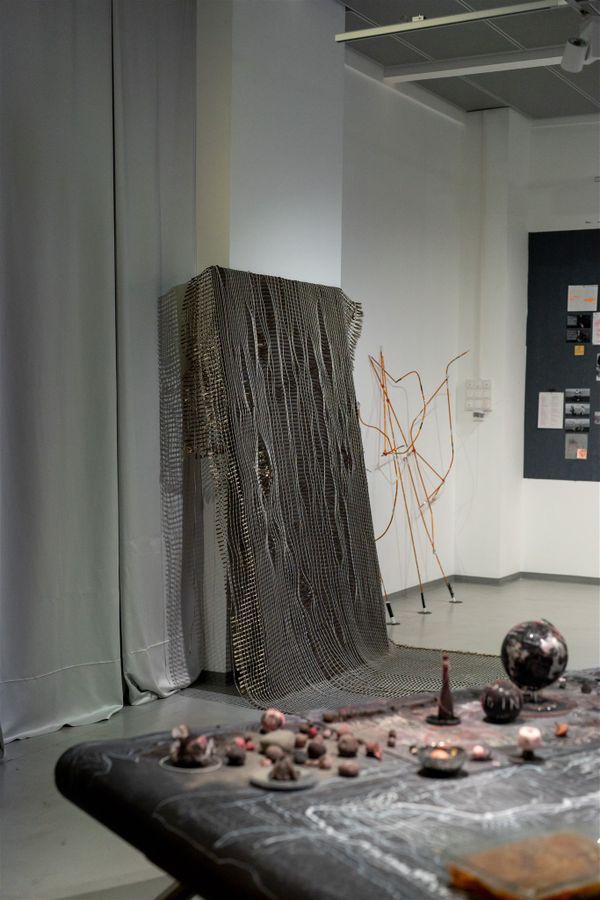
image

Exhibition View: Conceptual Joining – Wood Structures from Detail to Utopia

Investigation on wood constructions in a series of structural and spatial experiments from 2019

The exhibition focuses on two projects that explore the relationship between material, structure and space

Exhibition space with wood constructions from the exhibition | Image by ©
Kigumi tower | Image by ©
Wooden constructions on tables | Image by ©
Details of wooden constructions | Image by ©
Details floor, markers and wood branch standing | Image by ©
wood construction in total | Image by ©
Model for Wood construction | Image by ©
Team behind Conceptual Joining standing in front of a wooden tower | Image by ©Team behind Conceptual Joining

Conceptual Joining – Wood Structures from Detail to Utopia was shown at AIL in October 2019.

The artistic research project Conceptual Joining investigates wood constructions in a series of structural and spatial experiments. By combining the intelligence of traditional craftsmanship with the potential of computational techniques different design methods and techniques are developed.

The exhibition focuses on two projects that explore the relationship between material, structure and space. Branch Formations is about utilizing naturally grown wood elements as components of a spatial framework. In Interlocking Spaces joining principles, derived from traditional Japanese Architecture, are expanded by digital systematics, forming complex configurations. The working process and results of 2.5 years of research are presented. Full scale installations, models, videos and Augmented Reality allow for an interactive experience of an architectural speculation.

Projektteam:
Leitung: Christoph Kaltenbrunner

Forschungsteam: Lukas Allner, Daniela Kröhnert, Philipp Reinsberg, Mechthild Weber

MentorInnen: Karin Raith, Anja Jonkhans und Clemens Preisinger

Ein Projekt gefördert von österreichischer Wissenschaftsfonds (FWF) / PEEK Programm

Photos: Zara Pfeifer

image

Exhibition View: radical ⇌ matter

When Materialism is No Longer Enough

Jan / Feb 2024

radical matter: When Materialism is no Longer Enough offers a rigorous, playful, interdisciplinary approach to our contemporary real. Set against the hyperpolished atmospheres of robotically automated knowledge systems (RAS), generative and distributive intelligences, and wildly proliferating deep-fake narratives, this exhibition invites you to experience the infinite world of folds, psychedelic/neural sensory camouflaging, machinic aliveness and synthetic encounters – all part and parcel of our 21st century forms of agency, ethics, collective responsibility and new imaginaries.

Space 1

Image by ©
Image by ©Please note not all exhibited artworks are visible here or shown below.
Image by ©Planetary Skins, Sylvia Eckermann and Gerald Nestler. A performative mixed-reality art project, 2023
Image by ©Zoe, Noor Stenfert Kroese and Amir Bastan. Installation and documentation, 2023
Image by ©(front) Just One Word After Another, Mukul Patel. Deck of cards, 2023. (back) Fashion of Resistance, Manu Luksch. Concept costume, digital video, 2023
Image by ©(left) Charcot Flowers, Selina de Beauclair. Digital prints, 2023 / (right) Index Cards, Ivonne Gracia Murillo. Installation, 2023
Image by ©Planetary Skins, Sylvia Eckermann and Gerald Nestler. A performative mixed-reality art project, 2023 (Detail)
Image by ©AF 1138/3, 13945/1, 13945/4, 13945/5 and 13945/8, Tina Lechner. One gelatin silver print and four pigment prints, 2020-22
Image by ©In the Vertigo of Translations, Dario Srbic. 3D-printed platonic solids, photography, 2022

Space 2

Image by ©(back) Atlas of the Liminal: From Matter To Data, Manu Luksch. Giclée prints, 2021-23
Image by ©(front) Color Inventory, Bernhard Cella. Artbook installation, 2023 / (back) Candid 1571 and Candid 2391, Julian Palacz. UV printing on acrylic glass, 2020
Image by ©...presemic utterances and undulations... , Jonathan Boyd. Asemic Animation and installation, 2023
Image by ©The Sight of Clouds, Gerhard Lang. Three drawings, 2023
Image by ©Three Acrylic Paintings on Stands, Ashley Hans Scheirl

Dancing ever closer to strangely alive and deeply compelling humanmachineinterspecies co-evolutions, we find ourselves moving away from the old materialist canons of method, rationality and reason that asked: “supposing it could be otherwise, what would your otherwise look like” towards a slightly more graphic, urgent, raw, re-think: “supposing it already is ‘otherwise’”– how does this ‘otherwise’ enable new forms of agency, aliveness, and responsibility in the face of multi-modal generative Ai, non-conscious cognitions, TouchDesigner?

Our initial answers demanded a full ‘stripping-off’. A radicalmatter that demands: Strip away the old metaphysics of materialism! Strip off the speculative, object-oriented, historical or idealist well-past-their-sell-by-date wine in new bottles! Strip off these old knowledge systems which for so long have occluded new imaginaries, different forms of resistance, poetics, and libidinal economies. Take a walk with us on the wild side – a wild side that is already here, shape-shifting and proliferating.

Image by ©Color Inventory, Bernhard Cella. Artbook installation, 2023

Artists:

Amir Bastan, Sonia Bernac, Yasmine Boudiaf, Jonathan Boyd, Bernhard Cella, Clarissa Leonie Cohausz, Selina de Beauclair, Sylvia Eckermann, Maximilian Gallo, Johnny Golding, Ivonne Gracia Murillo, Tonica Hunter, Ajamu Ikwe-Tyehimba, Ameera Kawash, Jeremy Keenan, Gerhard Lang, Tina Lechner, Thandi Loewenson, Manu Luksch, Gerald Nestler, Jannis Neumann, Harold Offeh, Julian Palacz, Mukul Patel, Maggie Roberts, Ashley Hans Scheirl, Linn Phyllis Seeger, Dario Srbic, Noor Stenfert Kroese, Tanja Traxler, Shira Wachsmann, John Wild, Julia Wolf

Curatorial Team:

Johnny Golding, Martin Reinhart, Tanja Traxler

The Radical Matter exhibition and symposium is part of a PEEK artistic research project hosted by the Art & Science department at the University of Applied Arts Vienna in cooperation with the Royal College of Art London. We would like to thank the Austrian Science Fund (FWF) and all our project partners.

Photos: Lea Dörl

image

Exhibition View: Threads of Life

Textiles in Medicine and the Arts

Some insights from our current exhibition still on till 14 Jul 2023

About the multifaceted relationship between textiles, medicine and the arts. Presentation of historical and artistic positions that enter into a dialogue and generate productive tensions.

Image by ©Installation view. The exhibition took place in the right space of AIL.

Artists:

Sonja Bäumel, Pascale Maxime Ballieul, Camille Borchert, Ida Flora Frantal, Raja Goltz, Barbara Graf, Ruth Anderwald + Leonhard Grond, Elizabeth McGlynn, Ute Neuber, Katharina Sabernig, Hannah Schwab, Yuliia Strykovska, Leo Ruben Enosch Zellweger

Curatorial team:

Monika Ankele (Medical University of Vienna), Barbara Graf (University of Applied Arts Vienna), Katrin Pilz (Ludwig Boltzmann Institute for Digital History, Vienna), Monika Pietrzak-Franger (University of Vienna), Barbara Putz-Plecko (University of Applied Arts Vienna), Katharina Sabernig (University of Applied Arts Vienna), Georg Vasold (University of Vienna).

The curatorial team is part of the transdisciplinary working group History of Medicine and Medical/Health Humanities of the Austrian Academy of Sciences.

Image by ©Exhibition view at AIL
Image by ©

Selected Work:

Image by ©Katharina Sabernig, Darm, 2016
Image by ©Camille Borchert, Schnittstelle, 2022
Image by ©Barbara Graf, Tuch 7 – Naht, 2014
Image by ©Barbara Graf, Ohrobjekt mit Tasche, 2005
Image by ©Ruth Anderwald + Leonhard Grond, Dizzy Dress, 2023
Image by ©Pascale Maxime Ballieul, Making Kin with My Fictional Queer Ancestor: Being It Being They Being the Thing Being Frankenstein Being the Monster, or "Oh Jesus Chris, Lucifer is a Faggot!", 2020
Image by ©Sonja Bäumel, Textured Self, 2011

Although textiles have been indispensable to medicine since time immemorial, their role in this context has been understudied so far. From the surgical thread, wound dressings, wipes, pads, and protective clothing to the hospital bed, the practices of healing are unimaginable without them. But the relationship between textiles in the arts, wellbeing and health is much broader. It includes, but is not restricted to, the use of such techniques as knitting, crocheting, weaving or braiding in the development of cardiovascular grafts or surgical meshes. The use of textiles is also ambivalent. They have found use in psychiatric institutions for the bodily restraint of patients, but patients also used them for designing their environment and creating body wrappings as survival strategies. Textiles can also be a source of ill-health: Beyond the addition of harmful substances during their production, textiles have been used in fashion for centuries to shape, deform and discipline the body according to ideals of beauty. Practitioners from the fields visual arts and artistic research reflect on this complicated relationship in manifold ways. Artists use fabrics to evoke the vulnerability of the human body, its ongoing decay and imminent death, and also to highlight the complexity of interhuman relationships. They draw attention to (self-)care, understanding the human anatomy, perceiving one’s own corporeality, and to the ways in which textiles can become an existential embodiment. Beyond the metaphorical “Threads of Life”, suturing connects the craft of surgery with that of tailoring. The exhibition spotlights the multifaceted relationships between textiles, medicine and the arts. It brings historical objects and contemporary artistic positions into a dialogue that generates productive tensions.

Photos: Paul Pibernig

image

Exhibition View: Dementia Arts Society

Presentation of three years of Research from 2019

How can we meet the increasing challenges posed by dementia in our society?

How can we meet the growing challenges that the issue of dementia constitutes for our society? How can we help people with dementia participate in society as long as possible?

The goal of the research project Dementia. Arts. Society. (D.A.S.) is to employ artistic and design-based methods in order to raise awareness of people suffering from dementia as well as to offer them a new perspective on their own abilities and social life. The research team will present their preliminary findings in the context of this exhibition.

Ruth Mateus-Berr, Cornelia Bast, Antonia Eggeling, Elisabeth Haid, Pia Scharler, Christina Carli and Tatia Skhirtladze give insights into three years of research work and show results and findings developed during the project.

exhibition view | Image by ©

Supported by the Austrian Science Fund (FWF): AR 336-AG24

Photos: Lea Dörl

image

Exhibition View: Built to Grow – Blending Architecture and Biology

Growing As Building, 2015

Exploration of different pathways of Living Architecture, experimentation with biology, architecture and engineering

algue producing device with water and light | Image by ©
algue producing device  | Image by ©
objects and materials in plexiglass shelf | Image by ©
prints of material and structures on wall | Image by ©
objects in space, prints on wall | Image by ©
hanging 3D printer | Image by ©
structures and objects hanging in bigger structure, surfaces like skin | Image by ©

The underlying research work of the exhibition looks at growth patterns and dynamics from nature to apply them to architectural visions of a self-growing house. The exhibition presents ideas, approaches and concepts for grown structures evolved by an interdisciplinary team from the fields of architecture, art, biology, robotics and mechatronics. Work of 2,5 years artistic research will be presented in videos, photography, grown materials and objects and an artistic installation of a metabolic system including algae.

Further, this includes the outcome of hands-on experiments in a Biolab with biological role models such as the pathfinding slime mould, mycelium structures and metabolic systems around a novel 3D printer concept.

Two cable driven mobile 3D printers evolved through the research questions of the project GrAB and will be shown in the exhibition. Videos of conversations with different experts about agency, emergence and resilience including the immanent values and ethical aspects of this research will be on display to reflect and contextualize the work within our world of change.

Project lead:
Dr. Barbara Imhof, Dr. Petra Gruber

Project team:
Mag.arch. Waltraut Hoheneder, Dr. Tanja Oberwinkler, MA. Arch. Damjan Minovski, Viktor Gudenus, Ceren Yönetim, Mariya Korolova, Ioana Binica, Rafael Sánchez Herrera, Laura Mesa Arango, Andreas Körner, Mohammedneja Shikur

Cooperation Partner:
Dr. Angelo Vermeulen, Delft University of Technology, Participatory Systems, NL

Prof. Julian Vincent, University of Bath, Biomimetics, Mechanical Engineering, UK

Prof. Thomas Speck, University of Freiburg, Botanischer Garten, Plant Biomechanics Group, DE

Funding body:
FWF, Austrian Science Fund, PEEK Programme for Advancement and Development of Artistic Research

Connection at Angewandte: Institute of Architecture, studio Greg Lynn

Photos: Alicia Pawelczak

image

Exhibition View: Holobiont. Life is Other

Presentation of bodies, environments, texts, media, machines and biological organisms condensed into pictorial spaces / Oct 2022–Jan 2023

Curated by Judith Reichart, Lucie Strecker, Thomas Feuerstein, Jens Hauser

Exhibition view, please note the following presentation does only show parts of the artworks from the exhibition.
On Microperformativity, Wall paper based on the Journal Performance Research 25 (3), edited by Jens Hauser and Lucie Strecker with two monitors.

In the context of the exhibition, a multimedia wall newspaper presented artistic and theoretical contributions on the potential of microscopic physiological, chemical or biotechnological processes, taken from the journal ‘On Microperformativity’.

Microperformative positions ask how artistic methods can critically engage with technologies that manipulate life at the microscopic and molecular levels, merging around bio- and digital media. For this finissage the contributions by international authors of the special volume of the journal Performance Research 25 (3), ‘On Microperformativity’ were presented and discussed. The term microperformativity denotes a current trend in theories of performativity and performative artistic practices to destabilize human scales (both spatial and temporal) as the dominant plane of reference and to emphasize biological and technological micro-aspects that relate the invisibility of the microscopic to the intangibility of the macroscopic. Investigations into microperformativity redefine what art, philosophy, and the technosciences now consider ‘body’ at a time when performance art is moving toward a generalized and ubiquitous performativity in art.

Lucie Strecker – Brains’ Shit for Shit Brains (2020) / With literary text by KT Zakravsky

Brain's Shit for Shit Brains speculates on the importance of microbial diversity in sociopolitical contexts. Not only biobanks have recently been advertising the shit of celebrities, but pharmacological and medical research is also investigating the importance of microorganisms in the stool and their influence on mental and cognitive functions via the so-called microbiota-gut-brain axis.

Lucie Strecker designed a shooting gallery in which a microbial suppository becomes the grand prize. Porcelain anuses are the targets, placed in a coordinate system of social positions according to the French sociologist and anthropologist Pierre Bourdieu.

Lucie Strecker collected stool samples from people from different socio-political spaces and extracted microbes from them. They were preserved as a ‘pharmakon.’ The pharmakon is ambivalent in its effect: as magic and power it can be – simultaneously or consecutively – healing and damaging. For this installation, the literary artist KT Zakravsky wrote a literary game manual.

Henrik Plenge Jakobsen – Freiheit ist ein Geheimnis (2021). Teaching installation with a blackboard, bench, mylar curtains, stones from the Rickbach, Hörbranz.

The installation by Henrik Plenge Jakobson is an imaginative lesson with rocks from the lake waiting for their teacher to appear so she can begin her lesson on where the concept of freedom is hidden. It will likely be a complex session about existence and its relationship to the environment, and where exactly the cracks of emancipation can be found within that relationship.

ECOLALIA by Klaus Spiess / Ulla Rauter / Emanuel Gollob / Rotraud Kern (2022)

'The performance installation ECOLALIA uses artificial intelligence to uncover the complex balance between the needs of our oral microbiome and a future language. Our lab data show that the tonal, vibrating voice that unfolds primarily in singing and moaning stimulates microbes to grow, while the noise of alphabetic speech, as amplified by whispering, stresses oral microbes and causes them to die.’ — ECOLALIA makes a statement about the simultaneous loss of diversity of microbiota and languages. It shows in real time that the oral flora uses vowels differently from consonants for its growth. The flourishing of the flora, supported by artificial intelligence and a speech synthesiser, suggests new sounds for new languages.

Thomas Feuerstein, GREEN HYDRA (2021). Hydras (many-headed Hydra viridissima), green algae (Chlorella vulgaris), glass, plastic, pump technology, refrigerator

HYDRA (2021) by Thomas Feuerstein is a mouth-blown glass sculpture in the form of a many-headed hydra, inside of which freshwater polyps – called Hydra viridissima – are cultivated. The hydras live in a chamber of the sculpture filled with water and enter into symbiosis with chlorella algae. Through their transparent bodies, the chlorophyll of the microalgae glows and colors them green. Both creatures mutually complement their animal and plant metabolism and use light and plankton as a source of energy and food. – Symbiotic communities have gained metaphorical prominence in recent years in the debate over new models of society.

Maja Smrekar, Opus et Domus (2018). Glass house, metal spinning wheel, serotonin, dog hair, human hair, microfluidic lab system, hot plate

Maja Smrekar includes her Hybrid Family in the Opus et Domus by producing yarn from her dog companion’s and her own body hair that she collected since 2017, spun into a social fabric that was defined by their hybrid relationship, including artifially produced serotonine, an odoriferous mixture, combining serotonin taken from the blood of the artist with that taken from her dog. The advanced technology implemented into the installation serves to underline the contrast to the symptoms of the ever regressing society. The archetypal relationship depicted in this tableau vivant thus paraphrases a conclusion that the roots of politics are older than humanity; a thought suggesting that nowadays hybrid processes in society are solely political statements.

Close Reading – David Berry/Lucie Strecker (2021). Microphone stand, perforated plate, glass petri dishes, nutrient medium, PH index, Journal of Performance Research 25(3).

Close Reading by David Berry/Lucie Strecker (2021) — In literary studies, close reading refers to the careful interpretation of a passage of text, a precise reading that traces all textual details, nuances of meaning, and linguistic effects, focusing on the text as an object. Such an approach places great emphasis on the specific as opposed to the general, paying close attention to individual words, syntax, and the order of sentences and words.

As an installation, Close Reading is an invitation to visitors to select a short passage from the journal, read it aloud, and ‘discuss’ the Petri dish which is placed in the microphone stand with their breath and the microbes in it. The petri dish is closed and the quote is written on the lid. From that moment on, the individual microorganisms continue to grow on the nutrient medium over the period of the exhibition.

‘We’ experience ‘us’ as transitory beings drifting between digital and molecular worlds and sense the twisting of boundaries within us as the possibility of a new language beyond a symbolic distance from the world. With the exhibition Holobiont. Life is Other, the Angewandte Interdisciplinary Lab presents bodies, environments, texts, media, machines and biological organisms condensed into pictorial spaces – each of which represents a narrative about another life and about the lives of others.

More about the exhibition

With contributions by

Art Orienté Objet, Irini Athanassakis, David Berry, Julia Borovaya, Adam Brown, Juan M. Castro & Akihiro Kubota, Tagny Duff, Thomas Feuerstein, Karmen Franinovic, Ana Maria Gomez Lopez, Luis Hernan/Pei-Ying Lin/Carolina Ramirez-Figueroa, Hideo Iwasaki, Henrik Plenge Jakobsen, Eduardo Kac, Roman Kirschner, Lynn Margulis/Dorion Sagan/Bruce Clarke/David McConville, Yann Marussich, Agnes Meyer-Brandis, ORLAN, Špela Petrič, Chris Salter, Maja Smrekar, Klaus Spiess/Ulla Rauter/Emanuel Gollob, Lucie Strecker/KT Zakravsky, Tina Tarpgaard, Paul Vanouse, M R Vishnuprasad, Peter Weibel, and authors of the special issue On Micorperformativity, Performance Research: A Journal of the Performing Arts, 2020, 25 (3).

Scenography: Wolfgang Fiel, Institute for cultural policy

The exhibition was curated originally for the Magazin 4 exhibition space in Bregenz. The content was adapted and expanded for display at Angewandte Interdisciplinary Lab (AIL).

All photos: Lea Dörl