Follow-Up: Jona Wolf
Q&A with former Alumni in ResidenceJona Wolf is alumni of the institute of architecture and worked at AIL from September till October 2025
Jona Wolf studied architecture in Studio Greg Lynn and Studio Wolf D. Prix, and graduated in 2015. Using digital tools like 3D animation and CNC fabrication, they develop temporary spaces, objects and installations.
Their practice focuses on re-imagining and transforming educational models and collaborative creation. They are actively engaged in community building and activism, with a focus on empowering marginalised groups and resistance to state oppression. Jona is part of The Palace Collective, which currently runs an urban community project in Berlin.
Dear Jona, tell us briefly what you have been working on during your residency at AIL and how is the project progressing now?
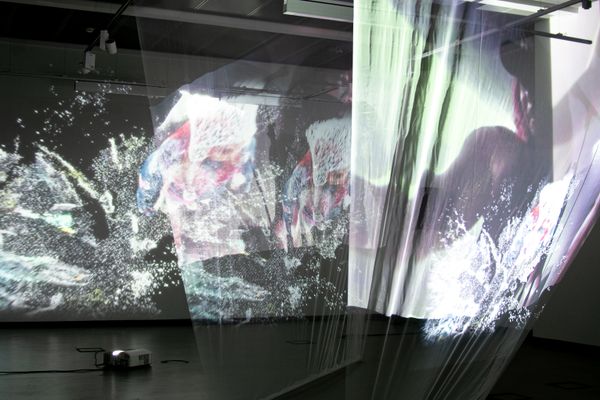
I picked an overarching topic around gender binaries in society and the political oppression of transgender rights. Within that framework I hosted a couple of events, film screenings and a workshop. In parallel I worked on an AV installation that I showed in the space.
I haven't directly developed the installation further since, but I continue to research the topic and expand on the media and methods I used. I was also able to connect with a lot of new people in Vienna, and I'm still in touch with them. There are conversations happening about future collaborations.
What has changed over the course of the residency, what process has been influenced, where has it developed or not and why?
The events I hosted gave me the chance to talk to people about my topic and understand their perspectives, the local context, and the kind of audience that would come and engage with my work. Originally I wanted to approach the topic in a much more abstract way, but I decided to make it unambiguous to get a clear message across. That led to a work that’s quite literal, almost educational. It was an interesting experiment and I’m still reflecting on what that means for my role as an artist.
What were inspiring encounters or experiences during your residency?
Coming back to Vienna – a city I have a lot of history and memories with, but also feel quite disconnected from after being away for a long time – I felt really welcomed. There was a genuine curiosity about my work that excited me and made me want to engage locally on a deeper level. I connected with a lot of people in a short time who were working on similar topics with their own tools, and I felt supported by them.
What does interdisciplinary work mean to you?
For me it’s about flexibility in techniques and a curiosity to use unfamiliar media and step into unfamiliar territory. I get bored pretty fast, which is why I like taking on new challenges. That also means learning to deal with failing and unpredictability.
Your practice moves between digital fabrication, installation, and community-based work. How does your background in architecture shape your approaches and interest and how do they come together in your artistic process?
All of these things have to do with space. I love observing and analyzing spaces. How different people activate and navigate them, the ephemeral qualities that create atmosphere, and the individual and collective memories attached to them. I think that curiosity was sparked somewhere in architecture for me and now weaves into all the different formats I work with.
As part of ‘The Palace Collective’ and other organizations in Berlin, you are deeply engaged in collaborative and activist work. How does collective organizing influence your understanding of authorship and artistic production? Your residency also became a collective and discursive space. How important are exchange, participation, and community-building within your practice?
The more I’ve facilitated opportunities and encouraged people to follow their own ideas, the more I’ve come to understand the joy in seeing people get excited about something. Whether it’s teaching at universities, facilitating workshops, or co-producing residencies – a lot of my creative energy goes into that, even if the output isn’t ‘my work.’ I’m more interested in the process itself: how we can find accessible ways to share knowledge and connect people in a way that has impact.
Being a trained architect probably helps too. Architects are used to working in large multidisciplinary teams to realize a project.
By working with technologies such as 3D animation and CNC fabrication, you engage tools often associated with precision, standardisation, or production. How do you appropriate these technologies to question normative ideas of bodies, gender, and futurity or how do they open up new perspectives on bodies, identities, and alternative futures?
These rather technical fields – 3D modeling, digital fabrication, VR – are very much dominated by a homogenous group, not necessarily a diverse crowd, who use those tools to tell their own stories. I don’t think it’s always intentional; people naturally bring their immediate reality to what they make. But being able to take up space within those environments, like at a conference, a university department, an exhibition, breaks into those same circles and exposes them to other realities, and hopefully empowers others to take up space too.
(Interview from June 2026, Questions: Elisabeth Falkensteiner, Eva Weber)