topic

From Counter to Encounter

Collection of installations and interventions at the cashier hall of Otto Wagner Postsparkasse

TOPIC CONTENT:

Under Otto Wagner’s roof

In spring 2021 AIL moved from the gallery space Franz Josefs Kai 3 to the former Postsparkasse, a historic landmark designed by architect Otto Wagner, and thus joining other departments of the University of Applied Arts Vienna into a newly emerging neighborhood comprising several research institutions from the field of art and science.

What are today’s most valuable currencies?

The new location provides the opportunity to further expand and strengthen networks for interdisciplinary work and research on an area of about 300 square meters, divided into three rooms on the mezzanine floor, with the former Kassenhalle (cashier hall) as its centerpiece.

The cashier hall is a general space for exchange. In addition to the AIL program, the AIL presents changing installations and interventions in collaboration with various university departments. The University of Applied Arts Vienna also runs Café Exchange in the hall. Below, you can find a selection of current and past projects.

research presentation

Opening: 02 Nov 2025, 11:00

Running: 02 Nov 2025 – 27 Feb 2026

POKING SYSTEMS – Celebrating Synfluence

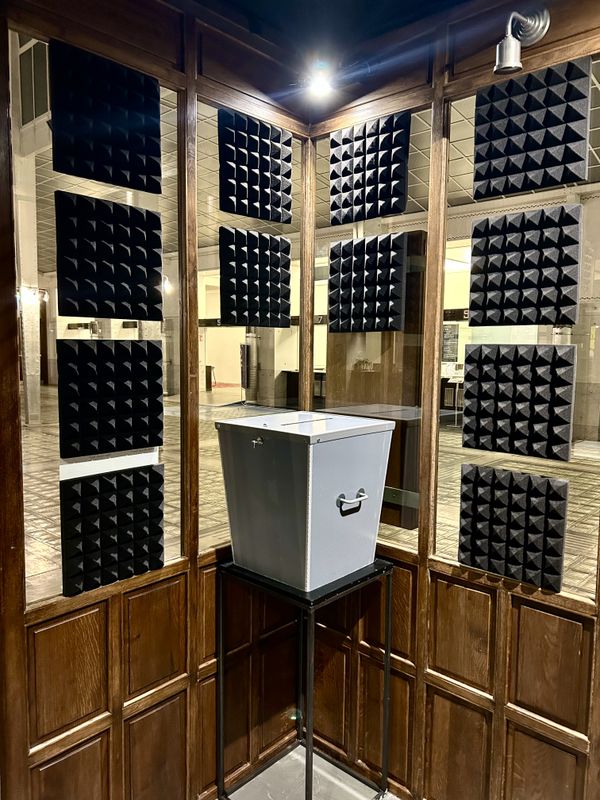
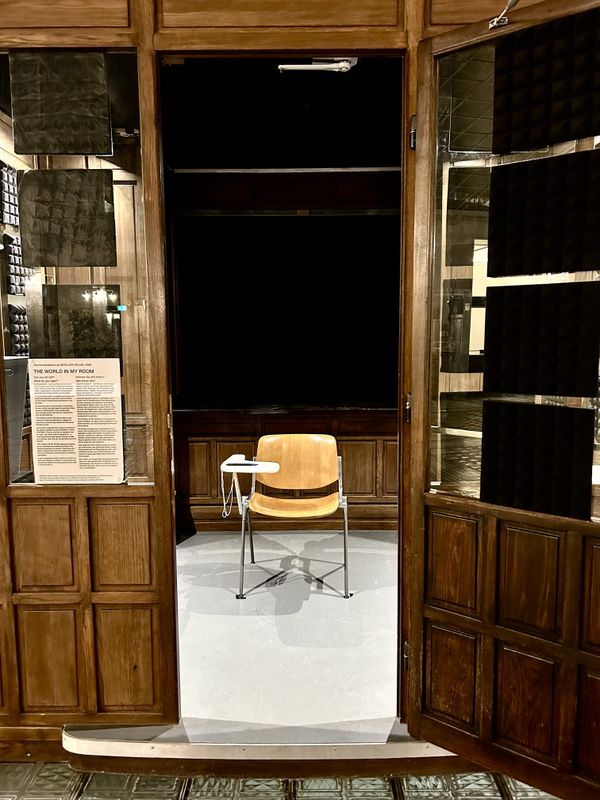
Arts-based Research-Installation by MUELLER-DIVJAK in the course of the artistic project SENSING LIVING SYSTEMS

Series of Scenographic Studies / Part VII, Nov 2025 – Feb 2026

It is not possible to rule, to dominate living systems such as animals and human animals, oceans and rivers, societies and cities, organizations and governments, jungles and forests, schools and universities, national and international economies, climate and the biosphere, in the long term through linear, mechanistic thinking or even violent interventions.

Living systems are in constant interaction with their environment and are constantly shaping and transforming themselves. They can be influenced in thriving directions if we try to understand their inner nature, their inherent rules, trying to understand them deeply, with all our senses. We can gently poke, stimulate them. We can rethink and shift our ideas about boundaries – and also enlarge our circles of empathy and care towards non-human and more-than-human nature.

This multisensory installation offers an instant sensual glimpse into the research process, and possibly pokes awareness concerning living systems.

Installation view, objects in the main counter of the cashier hall: Tree trunk standing on a pedestal | Image by ©

The staging of the so-called ’Poking Poles’ uses symbolic and written language as a means for data transfer. The words, phrases, and sentences inscribed on the surfaces of the artifacts, together with the fragile and ephemeral terms formed of powder on the floor, articulate and transmit findings that have emerged from the arts-based research project SENSING LIVING SYSTEMS. In particular, those from the workshops conducted in Europe and Southeast Asia, based on the General Systems Theory (Bertalanffy, 1968). Branches, collected in the woods and coasts at Songkhla (Gulf of Thailand) as well as boughs from the Vienna woods (Wienerwald), have been plastered, and labeled with black permanent marker, and arranged as a kind of magic forest of experience.

Inside a hollow tree trunk you find inscribed essences of knowledge about living systems – quotations from systems scientists and members of our artistic research team. Visitors are invited to reach inside and take a note. They can get in touch with the artists via the QR code on the back of the note to share their experience.

Hand reaching into the hole of an empty tree trunk | Image by ©

On the acoustic level, a barely perceptible sound can be heard. Composed of field recordings capturing the purring of two kittens (20–30 vibrations per second; 27–44 Hz) the origin of the vibration tones and their physiological circumstances have not yet been precisely explained scientifically. If we humans had the ability to purr, would we be able to sooth or eventually heal ourselves?

Olfactorily, the subtle aroma of Hedione (Methyl dihydrojasmonate), an aroma-chemical reminiscent of Jasmine notes, often used in perfumery for its sparkling and enhancing effects, lingers in the air. Studies have shown that Hedione activates the human pheromone receptor VN1R1, and we suggest that it may hold the potential to evoke feelings of trust and connectedness.

Artists / Researchers (core team): Jeanette Müller, Paul Divjak, Alexandra Graupner, Anna-Maria Irgang

Since fall 2023 AIL is part of the research project SENSING LIVING SYSTEMS together with the artist duo MUELLER-DIVJAK. The Otto Wagner Cashier Hall offers a special opportunity to give insights to processes and activities of SENSING LIVING SYSTEMS. For the first time, the historical cabin in the hall is used for ongoing artistic installations to make methods more visible, relatable and comprehensible for a public audience. As the cabin is surrounded by a broad audience coming together in the cashier hall, it offers a chance to gather feedback and reactions to the project and the specific stages of studies that will be incorporated into the project outcome.

FWF PEEK-Project DOI: 10.55776/AR 776 

Photos: Jeanette Müller, Paul Divjak

alumni in residence

Opening: 15 Oct 2025, 13:00

Running: 15 Oct 2025 – 30 Jan 2026

AIL Ping-Pong #2: Sample

Intervention at Counter 13 with Hubert Blanz, Margareta Klose, Marlene Lahmer, Rafael Lippuner, Mona Rith, Laura Stoll and Martin Veigl

Showcase of artistic projects by Angewandte alumni. Running: 15 Oct 2025 – 30 Jan 2026

In its second edition, AIL Ping-Pong circles around the term and meaning of “sample.”


 Presented in the small vitrine of the Otto Wagner Postsparkasse, seven graduates of the University of Applied Arts Vienna open a window into the diverse artistic practices and languages of Angewandte alumni, offering a range of perspectives that explore parallels, contrasts, or extensions within the given thematic framework.

While in the natural sciences, samples are collected to enable analysis and investigation, in music, the term “sample” refers to an excerpt from an existing recording that is integrated into a new composition. Similarly, in the visual arts, samples may emerge throughout the creative process – whether through experimental methods, the appropriation of external content, or the incorporation of elements from other disciplines, methodologies, or conceptual frameworks. Ideas, materials, methods, or visuals can be sampled. A sample can thus represent transdisciplinary collaboration or reflect a dynamic, exploratory process marked by iteration, testing, and discovery.

Hubert Blanz

graduated in 1999 from the Department of Sculpture (Bildhauerei). His artistic work deals primarily with urban infrastructures, spatial grids, and geographical and virtual networks. Within this context, megacities have emerged as a central theme: the rapid and constant development, the challenges and visions that accompany them, and the influence of these changes on our coexistence. In addition to elements of the big city, networks from nature also serve as templates for large-format collages and animations.

Margareta Klose

explores topics of coexistence within a queer-feminist, poetic practice. Her artistic work and research are situated at the intersection of fine arts, literature, education, knowledge production, and memory – centered around painting, writing, computational photography, and objets trouvés. In her work, she develops site-specific installations and performances that resemble cabinets of curiosities, scientific experimental settings, and artists’ studios – or rather: alchemists’ kitchens. At the University of Applied Arts Vienna, she studied in the Department of TransArts and graduated in 2020.

Marlene Lahmer’s

work is material-based and takes the form of sculptures, multimedia installations, and text performances. Literary and theory-informed approaches overlap translucently, incongruently, and at times complementarily. One of her main focuses lies in the aesthetic and physical qualities of glass, in the visual and auditory spaces found for texts, and in exploring concepts from cultural theory and linguistics. Lahmer graduated in 2022 from the TransArts department.

Rafael Lippuner

is an artist and exhibition designer who employs the processes of assembling materials, installing, and managing as artistic practices. The means of presentation are linked to the role of objects in terms of interaction and storytelling – especially in a time when images and symbols displace language. His multimedia works sample and intervene in everyday situations, structures, and codes to retain a certain wilderness in how we perceive our surroundings. In 2019, Lippuner graduated from the Department of Art & Science.

Mona Rith

is a textile artist, who weaves abstract objects and explores the possibilities between fixed structures and the limits of their dissolution. She plays with tension, shrinkage, and other material behaviors through weaving techniques combined with the inherent properties of the materials used. With great curiosity, Rith observes and investigates dependencies, interactions, and connections. She is an alumna of the Institute of Studies in Art and Art Education and graduated in 2021.

Laura Stoll

works in the fields of sculpture, installation, and performance. After earning a degree in medicine in Berlin, she graduated from the University of Applied Arts Vienna in the Department of Art & Science in 2021. In her projects, she operates at the intersection of medicine, psychology, and philosophy, applying individual methodologies from these fields to her artistic practice. Using a variety of formats, she investigates questions of personal identity and what constitutes our sense of being.

Martin Veigl

is a painter, interested in the smallest gestures and daily situations that convey social and historical codes and messages. Each found configuration can be seen as an unconscious, natural, and authentic fragment of reality. His paintings often do not fill the entire canvas, are fragmentary in nature, and suggest moments of memory. Veigl graduated from the Department of Painting in 2016.

With the aim of implementing playful interdisciplinary interventions in the unique space of the Kassenhalle, AIL Ping-Pong is a newly developed format that repurposes the building’s architecture – specifically a former display cabinet (in German: Vitrine) of the Otto Wagner Museum in the Kassenhalle – to showcase artistic projects by Angewandte alumni.

A project by AIL, supported by ARTist.

Concept and production:
Nora Mayr, Eva Weber

Jury:
Karl Salzmann (ÆSR Lab), Nora Mayr (AIL), Eva Weber (AIL)

Preview Image: Rafael Lippuner, o.T. (Feuerlöscher XI), 2025, Studioansicht 1

news

Angewandte Publications at AIL

Arts and science books by the University of Applied Arts Vienna now on display at the Kassenhalle of Otto Wagner Postsparkasse

Image by ©

A selection of publications from the arts and sciences by the University of Applied Arts Vienna is now at display at counter 9/10 of Kassenhalle and give you insights into the manifold acitivities. With around 200 publications released, Angewandte is the most active university in Austria in terms of publishing. Find all Angewandte publications here

Browse and leaf through some preview copies while enjoying the unique atmosphere of Kassenhalle!

Image by ©
Image by ©
Image by ©

AIL is located in the center of the Otto Wagner Postsparkasse building: in the former cash hall (Kassenhalle) and its two adjoining rooms. A space, designed for money transactions, is now being given a new lease of life as a public place of exchange. We think these times call for a space to get together, mix up ideas, put heads together, get in contact and exchange thoughts, knowledge, visions and utopias.

news

Schöne Grüße – (dis)honest images

AIL Postcard Edition Nr. 2. A cooperation with the department Applied Photography & Time-Based Media

Students of the course ‘Photographic Narration in Publication Formats’ led by Claudia Holzinger develop a series of postcards installed in the former cashier hall, Jun 2025 – Feb 2026

(dis)honest images

beauty in ugliness,

uncanny reality of human life.

against the supposed order of the body

something closer to truth, rawness and complexity.

silent performance of transformation.

nature seems synthetic

and art is instinctively honest.

reconstruct the inherited identity.

it makes you uncomfortable

thinking everything is a lie for a moment.

it’s also about humans,

everything we have done and can do and we have to live with.

Iconic drama – rage mode is on.

In collaboration with the Angewandte Interdisciplinary Lab, Claudia Holzinger’s Photographic Narration in Publication Formats course created a series of DIN A6-format postcards. Following the principle of silent mail, participants develop ideas and subjects through dialogue to create a ­coherent series together. Presented as an installation in the former cashier’s hall of the Postsparkasse, postcards can be taken and sent. In this place of exchange, we ­encourage you to stay ­connected.

With photographies from:

Pavle Banović
Amina Ben Hassen
Francis Grill
Yevheniia Kriuk
Yaroslava Melnychenko
Mihaly Mundruczo
Darryl Oswald
Almut Rist
Dunja Savić
Yuliia Sudarchykova
Zinaida Tsyhliuk
Daniel Wendt

The postcard edition will launch with Angewandte Festival.

This is the second postcard edition by AIL. Find more info abou the first edition here.

(dis)honest images, AIL Postcard Edition Nr. 2

AIL in cooperation with the department Applied Photography & Time-Based Media
Design: Atelier Dreibholz
Art Direction. Production: Eva Weber

Preview image: Daniel Wendt

image

On View: Supersachen

Impressions from the first ANGEWANDTE ALUMNI WERKSHOP / Part of Vienna Design Week 2023

A cooperation with ARTist – Alumni Association of the University of Applied Arts Vienna

Image by ©Opening: 28 Sep, 18:00 / Shop Opening Hours 29-30 Sep 10:00–18:00
Image by ©
Image by ©

As part of Vienna Design Week 2023 AIL and ARTist, the alumni association of the University of Applied Arts, put up for sale a selection of works and Supersachen (awesome things) by former students.

Around 100 pieces of work – ranging from design objects, artworks, products, unique pieces and small editions – from 41 alumni were presented in this pop up shop project.

Image by ©
Image by ©
Image by ©
Image by ©

The leading questions are: What do former students work on these days? What ‘treasure’ do you want to take with you? Which Angewandte souvenir could you pick? Where do special editions, unique items, test products and side projects end up? Which works of art are in search of a new home and might be the cornerstones of a new and singular art and design collection?

Image by ©
Image by ©
Image by ©From the Opening Night on 28 Sep 2023

With contributions by:

Georg Adam, Zeynep Aksöz und Mark Balzar, Sonja Bischur, Laura Dominici, Lara Erel, Bernhard Faiss, Juliane Fink, Max Freund, Jakob Glasner, Simone Göstl (sicago), Martin Grödl & Moritz Resl (Process Studio), Theresa Hattinger, Anna Holly (hollyaroh), Norma Kiskan, Matthias Krinzinger, Daniela Kröhnert (DARK), Ivana Lazić, Julia Neckel, Silvia Pachler, Wolfgang M. Pachler, Nayeun Park, Kerstin Pfleger und Peter Paulhart (Reduce Design), Johanna Pichlbauer, Simon Platzgummer, Jakob Posch (Aito), Katja Protchenko, Mona Rith, Hedwig Rotter, Simon Sailer, Georg Sampl, Emanuel Scheib, Laura Schreiber, Vanessa Schreiner, Alessia Scuderi, Raphael Volkmer und Max Scheidl, zusammen mit Julian Jankovic und Florian Schäfer (FANTOPLAST), Astrid Seme, Szidonia Szep, Tanja Taborin, Valerie Tiefenbacher, Vera Wiedermann, Bettina Willnauer, Petra Zimmermann, Sicc.Zine (Lukas Brunner, Merlin Dickie Marlene Heidinger, Silvia Knödlstorfer, Lenz Mosbacher, Miryana Sarandeva)

This ‘Werkshop’ is supposed to act as a blueprint for similar future editions that will take place on a regular basis and might become an integral part of the University of Applied Arts.

All images: Paul Pibernig

Project management and concept:

Edda Thürriedl, Eva Weber

Display Architecture: Wolfgang Fiel

Graphic Design Display: Atelier Dreibholz

image

Exhibition View: Showing Echoes

From counter to encounter / Part of Angewandte Festival 2024

Elisabeth Falkensteiner and Nora Mayr in cooperation with departments from the Postsparkasse building

Image by ©Canal Dipping Community, 2024 / Malak Hamadeh, Egor Safronov, Sarah Zelt from the department Transformation Studies. Art x Science
Image by ©
Image by ©Decisions, 2024 / Final thesis of the Bachelor graduates from the department Cross-Disciplinary Strategies
Image by ©Eco-Circuitry: Moss and Machine, 2024 / Catalina Escalona / Image created using a deep generative artificial neural network together with the Coding Lab
Image by ©
Image by ©Portal, 2024 / Clara Hirschmanner, Georg Luif, Margarete Jahrmann from the department of Experimental Game Cultures
Image by ©
Image by ©Pseudomorphia, 2024 / Rage from the department of Digitale Kunst
Image by ©
Image by ©
Image by ©Out of the Frying Pan into the Fire / Sophie Olivia Taleja Schmidt, Márton Zalka from the department of Art&Science
Image by ©huānyíng noise, 2024 (Megaphone) / Maria Bürger, Olivia Cavallari, Famkje Elgersma, Marcus Kautz, Mirjam Kislinger from the department IPSD / International Programmes in Sustainable Developments — Open Stage, 2024 (Projector) / from Angewandte Performance Lab

In the heart of the former postal savings bank, the AIL interweaves references to the themes and questions addressed in the exhibitions and projects of the various classes and departments housed within Otto Wagner's building during the Angewandte Festival 2024.

Students and members of the various departments (Digital Arts, Art & Science, Angewandte Performance Lab, Peter Weibel Institute, Art&Science School for Transformation, Coding Lab, Experimental Game Cultures, Global Challenges and Sustainable Development) show snippets, add-ons or playful hints of the main exhibition in their calssrooms. They provide concentrated insights into artistic discussions and methodologies, offering a comprehensive view of the contributions throughout the building.

All images: Hannah Mayr

image

Installation View: Cycloïd-E

Sound installation by COD.ACT, part of Wien Modern 2024

Find the second part COD.ACT: πTON/2 at MAK Forum

Image by ©
Image by ©
Image by ©
Image by ©
Image by ©
Image by ©
Image by ©

Cycloïd-E arose from the desire to develop a mechanism that produces visible wave movements and to relate this to the development of sound waves.

A pendulum is placed horizontally and gravity is replaced by a motor. The pendulum consists of metal tubes equipped with sound sources and measuring devices that cause the tubes to resonate depending on their rotational movements. The result is a sequence of unpredictable movements. The balance of energy exchange in the different parts approaches perfection, the resulting trajectories are surprisingly precise and natural. It is all about absolute harmony. During its fascinating and hypnotic dance, Cycloïd-E explores the space created by the sound trajectories of this unique kinetic and polyphonic work of art – a little like the ‘Cosmic Ballet’ referred to by Johannes Kepler in his Music of the Spheres in 1619. (Cod.Act)

Cod.Act: Duo (André Décosterd: Installation, Music) and Michel Décosterd: Installation, Music

André Décosterd completed an apprenticeship as an organ builder in Neuchâtel before studying at the École de Jazz et de musique actuelle (Ejma) in Lausanne, where he subsequently specialized in programmed music and algorithmic composition. Michel Décosterd studied architecture at the engineering school in Biel (graduated in 1994). The visual artist began his career as a photographer before turning to the construction of translucent kinetic devices. In 1997, the two brothers founded the Cod.Act group, which worked closely with the engineer Jacques Décosterd (1936-2024) in the fields of industrial informatics and automation until his death.

The group's artistic and scientific work focuses on machines and objects that translate spaces and movements into sound and thereby develop a surprising, quasi-organic life of their own. The sound objects developed by the brothers often move autonomously and thus open up a surprising encounter between sculptures and their viewers. Cod.Act operates at the interface of sculpture, architecture, performance, sound and music. André and Michael Décosterd have realized numerous international exhibitions and received a number of prestigious awards, including the Golden Nica at Ars Electronica Linz and three times a main prize at the Japan Media Arts Festival. In 2019, Cod.Act was awarded the Swiss Grand Prix for Music.

All images: eSeL.at/Wien Modern

image

Posthuman Social Club at AIL

Performance and film screening from April 2024

An event presented by andother stage

Image by ©
Image by ©
Image by ©
Image by ©
Image by ©
Image by ©
Image by ©
Image by ©

This 3rd edition of the posthuman social club is devoted to the philosopher Isabelle Stengers. We will be hosting the Austrian premiere of her biopic Isabelle Stengers – Building Hope on the Edge of the Abyss, by Fabrizzio Terranova and curating a program of performance, music and somatic lecture devoted to her extensive body of work.

Isabelle Stengers is not only known as one of the leading thinkers for ‘post-humanist’ discourses and practices, but also for her ecologically oriented philosophy in general. Her decades of work on sciences, politics and ecology has influenced many prominent scholars such as Donna Haraway and Bruno Latour.

With the event series posthuman social club we want to think outside of the box of what has been labeled ‘the human realm of reason’ and develop new regimes of perception, sensuality and physicality, that can with care and consideration, lead us on the path from our humanist-exclusivist tradition to more inclusive approaches of sharing our many worlds with other forms of existence. In the permeation of choreography and composition, with club culture, philosophy, ecology and media art, we want to explore what a post-human social – or even a post-human society – could actually mean. We cannot overcome the euro- and anthropocentric, often misogynistic and racist tendencies of the ‘Enlightenment’ tradition overnight. The 'posthuman social clubs’ are a sensual approach, cultivation, celebration, differentiation and problematization of these [post-human] desires.

Isabella Forciniti – analogue synthesizers, electronics, performance

Kilian Jörg – performance, lecture

Mirjam Klebel performance

Otto Krause – costume-contribution

Alfredo Ovalles – keyboards, electronics

David Panzl – percussion

Jorge Sánchez-Chiong – turntables, electronics

Samuel Toro Pérez – e-guitar, electronics

Brigitte Wilfing – voice, turntables, performance

andother stage – transdisciplinary assemble for choreographic composition and artistic research – is not the longing for another stage, but for slipping and wriggling between spaces and discourses, be it at the kitchen table or on a large stage. Assemble refers to music because of its proximity to the ensemble, but we also want to affirm an assemblage of people, disciplines, media, instruments, objects and discourses alongside other forms of playing together. Founded in 2019 by Brigitte Wilfing (choreographer) and Jorge Sánchez-Chiong (composer).

A production by andother stage in cooperation with Angewandte Interdisciplinary Lab (AIL) Supported by the City of Vienna Culture (MA7).

All images: eSeL

news

Pop Up Book Shop: o*books

o*books is a place full of diverse stories that inspires, motivates and communicates diversity. Newly opened in 1020 Vienna, we are happy to host o*books with a special selection

1 Dec–16 Dec 2022 // Tue–Fri 12:00–18:00

‘Inspiration, motivation, courage, diversity, knowledge, but also fun, relaxation and excitement, inventiveness, curiosity and a heap of imagination, books can do all that, in whatever form. We want to deal with all of this, but also with the imbalance that is just as prevalent in the book industry.

That’s why we’ve decided to focus on issues that can bring needed change for us and our society. We see feminism, queerness, LGBTIQ*, anti-racism, diversity and inclusion not just as buzzwords, but learn them, live them and read them every day.

We want to see and appreciate the world in all its diversity. All those books that already exist and those that will exist create this space.

We just have to read them.’

This is how Bianca and Katja from the newly opened book shop o*books describe their vision and program, we are more than happy to welcome them in December with a special selection.

Choose your topic, choose your book, choose to read!

The Pop Up Book Shop will be open Tue–Fri 12:00–18.00

Event flyer from o*books | Image by ©

o*books is orginally located at
Bruno-Marek-Allee 24
Top 1 1020 Wien
Mon–Fri 10:00–19:00
Sat: 10:00– 16:00

image

Performance View: Salon de Passage #3 – Gathering, Hunting, Cultivating: Green

Passenger Diaries – Performative Research on Emergent Subjectivities in Trans-Urban Space

Reserach Presentation at Café Exchange from May 2022

Salon de Passage Performance setting with carpets, flowers, tea and pastries | Image by ©

We are living in strange times as all around us our relationships with our diverse environments change, and must change. We are already used to calling this change ‘climate change’. But have we already understood what this really means? The experimental project Passenger Diaries keeps a diary of a journey into another life in the close neighborhood – life that is as personal as it is oriented towards the environment, urban and suburban spaces. To enter this close range is itself the passage we seek. The researchers turn collectively into The Passenger, inspired by Iggy Pop’s mythical song and understood as a ‘cloud’, a ‘state of mind and body’, with pronouns they, them and theirs.

The Passenger will share diary entries that tell of cruising through ‘trans-urban spaces’ and newly discovered psychogeographies. In particular, the colour green and how it can be found along Vienna's railings will be explored in the form of contributions by invited guests and experts from the fields of architecture, visual arts, heritage conservation, media theory and curatorial practice:

To this end, Heinrich Büchel draws on a green board spatially structural about ‘everything inside, everything outside - because what is inside is outside’, Thomas Feuerstein talks about green unicorns in paradisiacal gardens and how he finally married a plant, Jens Hauser introduces the practice of ‘hunting for green’ and discovers this very colour to be particularly anthropocentric, Robert Linke deconstructs the myth of the so-called ‘Otto Wagner green’ using the example of Vienna’s city railway, while Judith Reichart asks how red-green color blindness has an impact on art and design production and perception.

Salonnières: Mariella Greil, Lucie Strecker, KT Zakravsky

Contributors: Heinrich Büchel, Thomas Feuerstein, Jens Hauser, Robert Linke, Judith Reichart

Design consultancy: Daniel Büchel

Teatime provision: Alexander Afrough

All images: Lea Fabienna Dörl